
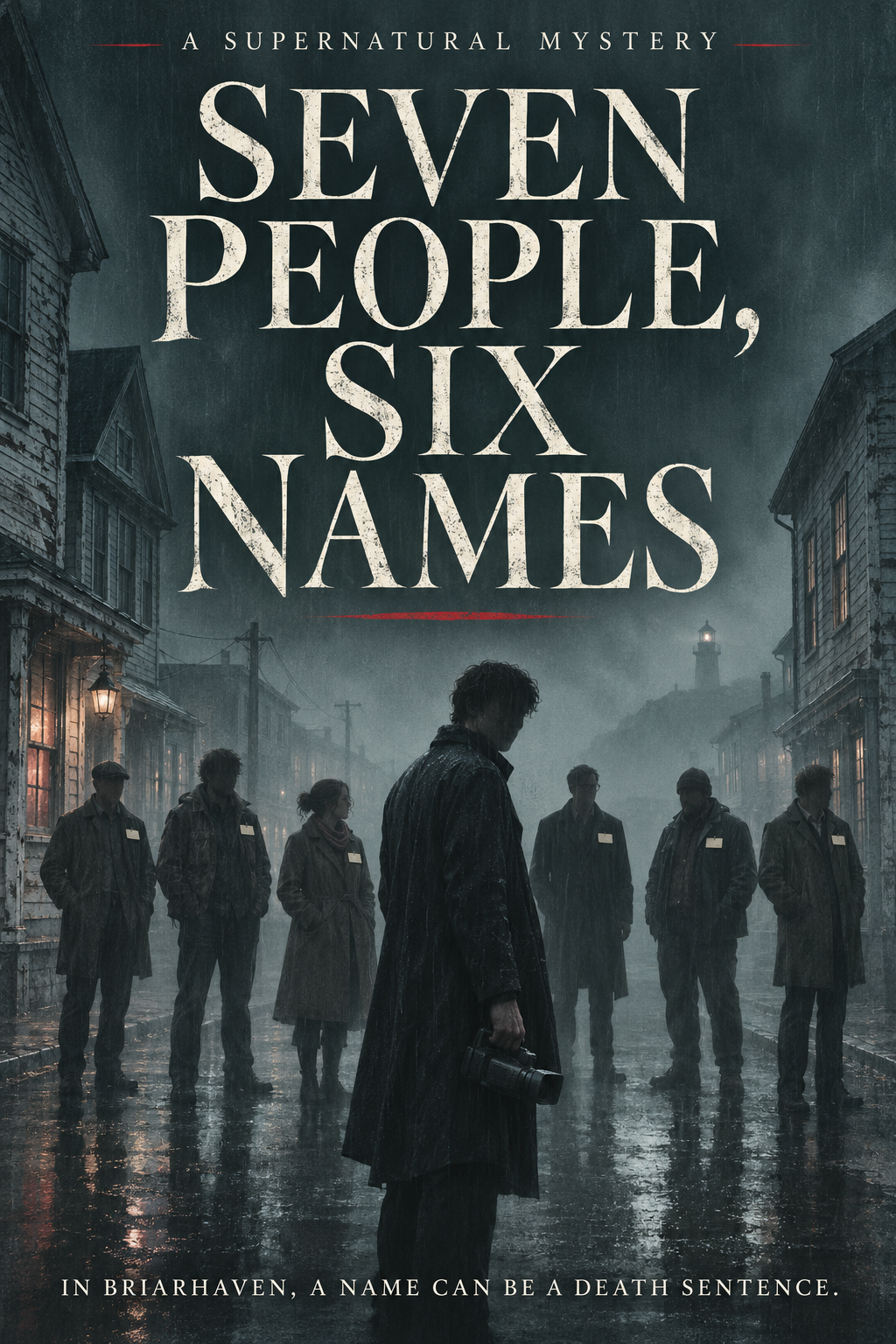
Prologue
The tape ran forty-seven seconds.
A long table. Seven name tags on it. Six had names, handwritten, ink still wet. The seventh was blank.
The camera pulled back. When it reached the seventh tag the image jumped once, then cut to black.
No audio. Not one sound the whole time.
The Bureau archivist logged it as Item Zero-Seven, origin unknown, contents unclassifiable. He hesitated at the remarks field before writing:
“No cameraman present in frame.”
Someone went over those four words later with red ink. Pressed hard enough to tear the paper.
Chapter One: The Seventh Person
Evan Reed came to when the bus had already stopped.
Not a station stop. The engine had cut out. Without it the only thing left was the hum of a ballast in the ceiling light, and that light was flickering, irregular, the way a light flickers when someone somewhere is toying with the switch.
He sat up. His neck was dead from sleeping crooked. The seat under him was cracked vinyl, yellow foam showing through the split. He recognized the type. Late eighties transit seats. These should have been junked a decade ago.
Six people in the bus.
All of them awake. All wearing the same dark gray jacket, each with a name tag the size of a playing card pinned to the left chest. Hard plastic, edges gone white from wear, names written by hand.
Evan Reed looked down at his own chest.
Nothing.
He ran his hand over the spot. New jacket, buttons all there, fabric smooth, just bare. No tag. He checked his pockets and came out with a booklet. The cover had been soaked, pages wavy, the title Ghost River Hell blurred to nothing. Inside the front cover, in pencil, so faint he almost missed it:
“Four cases in Honghua.”
“You don’t have one either.”
The voice came from the front row. A woman. Short hair, pale, dark smudges under her eyes. She’d turned around to look at his chest.
“Yeah,” Evan Reed said.
“Claire Bennett.” She put her hand out. “You?”
“Evan Reed.”
“Evan Reed.” She said it back to him, the way you repeat a word to see if it sounds wrong. “Archives?”
“Video forensics.”
“Makes sense.” She smiled, but only with her mouth. “They threw you in because you can read footage.”
Evan Reed let it go. He was counting the six.
Front seat: a man in his early forties, heavy in the shoulders, who hadn’t moved the whole time. Like he was braced for something. His tag said Grant Walker. Beside him a tall, narrow man with long fingers rolling a pen between them. Miles Shaw. Behind those two, a pair who could have been brothers. One had his eyes shut, the other was wiping his glasses. Adam Hayes. Ben Hayes. By the door, a middle-aged man with glasses, leafing through his booklet. Henry Collins.
Six people. Six tags.
Him, seven.
“The announcement said six,” Evan Reed said.
“It did.” Claire Bennett’s voice was flat. “It counted six.”
The door broke open with a hiss.
No platform out there. No streetlights. A strip of asphalt and a wash of light at the far end. The air had a smell to it. River mud brought up from the bottom, brackish, with something sweet underneath it.
Grant Walker was first off the bus. He stopped in the doorway and looked back. Not at Evan Reed. At the back corner of the bus. Nothing back there but a seat cushion curling up at the corner.
He held on that for two seconds, then turned.
“Let’s go.”
Honghua
Honghua was one street.
Shops on both sides were shuttered, roll-down doors left halfway. But the signs faced the wrong way. They were turned inward, text against the wall, like they didn’t want to be read from the street. Evan Reed passed a barbershop. A price list taped to the glass door, red paper, black ink, the last line: Closed Today.
The streetlights were on but the bulbs were yellow. The light sat on the asphalt thin and greasy.
At the end of the street a three-story building, a wooden sign by the door: Honghua Visitor Reception.
Someone was home. An old man in a blue work jacket sat behind the counter with his head down, gluing a chipped teacup. Taking his time with it, careful, the way you handle something that matters more than it should.
“Register,” he said, without looking up.
“Six rooms,” Grant Walker said.
“Six.” The old man said it back. Then he raised his eyes and counted them, one at a time. His gaze stopped on each face. When it got to Evan Reed it hopped over.
Not that he hadn’t seen him. He skipped him. The way you skip a bead on an abacus without meaning to.
“Six.” He said it again. Pulled six keys from a drawer and laid them on the counter.
Evan Reed was last. He waited until everyone had taken a key and then he stepped up.
“Mine?”
The old man looked up. His eyes were clouded, gray film over them. He looked at Evan Reed a long time. Long enough that Evan Reed started to wonder if the man could hear.
Then:
“You’re not on the list.”
“What list.”
The old man pushed a piece of paper across the counter. Grid paper, six names in brush ink, each stroke laid down slow and careful.
Grant Walker. Miles Shaw. Henry Collins. Adam Hayes. Ben Hayes. Claire Bennett.
Six lines. Under the sixth, a seventh. Crossed out. Scrubbed over so hard the ink had bled clean through.
Evan Reed turned the paper over and held it up to the light.
Pressure marks on the back. Whoever wrote it had leaned too hard. The pen had grooved the paper, and he could trace the shape of the seventh name with his fingertip. Three characters. First stroke horizontal, last stroke a downward hook.
But no ink on the back. Just the grooves. Written, then wiped.
“Who was this?” he said.
The old man bent his head back over the teacup.
“Nobody,” he said. “That’s the seventh seat. It’s empty.”
The Common Room
At eleven that night they met in the common room on the first floor.
Grant Walker laid the booklet open on the table. The six of them had been issued copies of Ghost River Hell. Evan Reed’s was the seventh. Same contents. The booklet was thin, a dozen pages. The front half was waterlogged, the text smeared to pulp. Only the last two pages were readable. A verse, set vertically, no punctuation:
Bodies may be traded, names may be traded
Two who are one, one trade per pair
One stick of incense behind a closed door: flesh to dust, the head alone remains
The one who speaks and the one who hears, both perish
Lamp lit, the person stays. Lamp out, the person comes back
“What’s it mean?” Ben Hayes said.
“Don’t know.” Grant Walker didn’t look up. “First six pages are gone. This is what’s left.”
“So what are we going in for?” Ben Hayes said. “To die?”
“We go in to get out.” Grant Walker shut the booklet. “Bureau gave us one job. Four cases. Find the ghost. Bring the answer back.”
“Where’s the ghost?”
Grant Walker didn’t answer. His eyes went to Claire Bennett.
Claire Bennett was in a corner chair, looking at her hands. Her fingers were white. Nails cut down to the quick.
“I don’t know,” she said.
“You do.”
“I do.” She raised her head. Nothing on her face. “But I can’t say it. The second I say it, I’m dead.”
Nobody said anything for a few seconds.
Evan Reed put the camcorder on the table. Bureau issue, the size of a fist, red light already on.
“I’ll film,” he said. “Nobody talks about this again.”
The First Case
The first case started at seven the next morning.
A minibus outside the reception office. A cardboard placard wired to the front grille: Honghua Mortuary Direct Line. The driver had no face. Not in the way a mannequin has no face. His features were there but covered over, a layer of gray-white paste troweled on, the way you paste wet paper to a wall.
Six of them got on. Evan Reed tried to board and the driver’s hand came up.
The hand just stayed there in the air. Didn’t touch him. Didn’t push. Just held the space.
“Full,” the driver said. The voice came from behind that paste, muffled, like hearing someone talk through a wall.
“Six seats.” Grant Walker glanced back once. Then he turned and said nothing else.
The doors shut.
Evan Reed stood on the road and watched the minibus pull away. Tail lights blinked red twice through the fog, rounded the bend, and were gone.
He looked down at the camcorder. Red light on.
He pointed the lens at himself to record a note. The screen showed the reception building behind him. Gray walls. Wooden door. The chipped teacup still on the front step.
He stepped to the side.
The image moved with him. Gray wall. Wooden door. Teacup.
No person.
Evan Reed brought the camera down and waved a hand in front of the lens. A hand’s shadow crossed the screen, there and gone.
He put the lens back on his own face.
The screen showed the gray wall. Nothing else.